
IOP
The Exhaustion of Looking Fine While Quietly Falling Apart

Written By
IOP
Written By
From the outside, people like you rarely look like they need help.
You show up early.
You meet deadlines.
You return calls and texts.
Your life functions.
But we’ve worked with many people whose lives looked exactly like that—until they admitted something quietly painful:
They were functioning.
But they were exhausted.
For some, the turning point begins with exploring options like multi-day weekly treatment that allow people to address substance use and emotional strain while still maintaining work, family, and responsibilities.
Because for high-functioning people, the problem usually isn’t collapse.
It’s the slow grind of holding everything together alone.
One client—we’ll call her Melissa—came to us after years of what most people would call success.
She had a demanding professional career.
She managed a busy schedule.
She showed up for family gatherings and birthdays.
No one would have guessed she was struggling.
Melissa described her life this way:
“From the outside, it looked organized. Inside, it felt like I was duct-taping everything together.”
Her drinking started as stress relief after long workdays.
At first it felt harmless.
A glass of wine while answering emails.
A couple of drinks after tough meetings.
But over time, that habit became the way she ended every day.
It was the only moment she felt like she could finally exhale.
High-functioning individuals often develop one powerful skill.
They become experts at managing appearances.
They manage stress.
They manage emotions.
They manage how others see them.
Melissa told us something we hear often:
“I wasn’t falling apart. I was just really tired.”
That exhaustion didn’t come from one crisis.
It came from the constant effort of maintaining two versions of life.
The life everyone saw.
And the one that unfolded privately when the day finally ended.
Over time, that balancing act becomes heavy.
Not dramatic.
Just quietly draining.
For years, Melissa told herself the same thing many high-functioning people believe.
“I’m not that bad.”
She compared her life to the most extreme stories she’d heard.
People losing jobs.
People going through legal trouble.
People whose lives had visibly collapsed.
As long as she wasn’t there, she convinced herself she didn’t need help.
But comparison can be misleading.
Because addiction and substance use problems don’t always announce themselves loudly.
Sometimes they grow quietly.
They shrink your emotional world little by little.
You still show up to work.
But joy fades.
You still attend social events.
But connection feels thinner.
You still move forward in life.
But something inside you feels stuck.
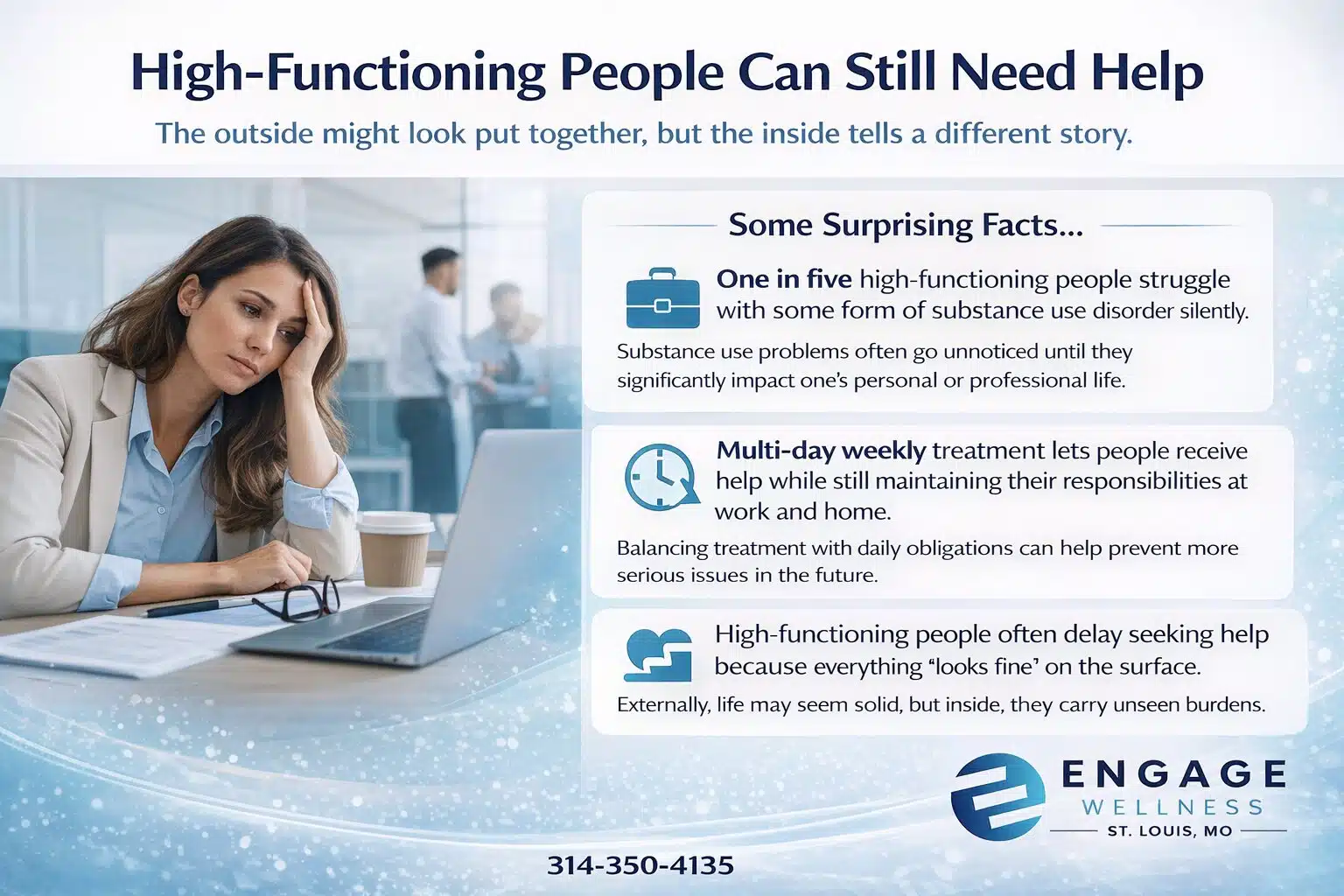
Melissa didn’t hit rock bottom.
Her turning point came during a completely ordinary evening.
She was sitting at home after work, pouring another drink while scrolling through emails.
Suddenly she noticed how automatic everything felt.
Same routine.
Same coping pattern.
Same quiet dissatisfaction at the end of the day.
She described the realization like watching a rerun.
Different night.
Same ending.
That’s when a thought appeared that she couldn’t ignore:
“What if nothing changes?”
Not tomorrow.
Not next year.
But five years from now.
The idea that life might stay exactly the same scared her more than any crisis.
Many people assume treatment only becomes necessary after disaster.
But high-functioning individuals often reach their turning point earlier.
Not because they’ve lost everything.
Because they notice the pattern.
The routine that’s slowly narrowing their life.
For Melissa, the realization wasn’t about losing control.
It was about losing possibility.
“I realized I wasn’t building anything,” she said.
“I was just maintaining.”
That insight pushed her to explore options like Intensive Outpatient Program care—support designed for people who still have responsibilities but need structured help to break patterns that aren’t working anymore.
One of the most powerful moments in treatment often happens early.
It’s the moment someone says the truth out loud.
Not the polished version.
The real one.
“I’m exhausted.”
“I don’t like how dependent I’ve become.”
“I feel like I’m stuck.”
When high-functioning people begin speaking honestly, something shifts.
The pressure of pretending begins to lift.
They realize they’re not the only ones living this way.
Other professionals.
Other parents.
Other people who seemed completely fine.
Once that illusion cracks, change becomes possible.
Melissa didn’t wait until everything collapsed.
She chose change while her life was still intact.
She kept working.
She maintained her responsibilities.
But she also began rebuilding healthier ways to manage stress, relationships, and emotional pressure.
That shift didn’t happen overnight.
But over time, something changed.
She started sleeping better.
She started feeling more present in conversations.
And slowly, the constant exhaustion began to fade.
Her life didn’t explode into dramatic transformation.
But it expanded.
And for many people, that’s the real goal of recovery.
Not just surviving.
But feeling alive again.
Yes. Many people maintain careers, families, and responsibilities while quietly struggling with substance use or emotional burnout. Success on the outside doesn’t always reflect what someone is experiencing internally.
Because their lives still appear stable. Without obvious consequences like job loss or legal trouble, it can be easy to believe the problem isn’t serious enough yet.
Feeling emotionally exhausted, relying on substances to manage stress, losing interest in activities that once felt meaningful, or noticing patterns that feel difficult to change are common signs.
Not always. Some treatment options are designed specifically for individuals who need support while continuing their professional and personal responsibilities.
Admitting that something isn’t working anymore. Many people are used to solving problems independently, so asking for help can feel unfamiliar at first.
Sometimes the problem deepens. Addressing struggles earlier often allows people to regain control before consequences escalate.
High-functioning people often carry struggles longer than anyone realizes.
Not because they’re weak.
Because they’re capable.
They know how to keep things moving.
But capability can also hide the moment when support would help most.
If something inside you feels tired of managing everything alone, that feeling deserves attention.
You don’t have to wait for life to collapse before choosing something different.
Sometimes the most powerful decision is choosing support while your life is still standing.
If you’re quietly wondering whether deeper support could help, compassionate guidance is available. Call 314-350-4135 or explore our multi-day weekly treatment options to learn more about Intensive Outpatient Program services in Missouri.




© 2025 Engage Wellness Acton, MO. All Rights Reserved | SEO by DIGITECH | Sitemap | Privacy Policy
© 2025 Engage Wellness Acton, MO. All Rights Reserved | SEO by DIGITECH | Sitemap | Privacy Policy