
IOP
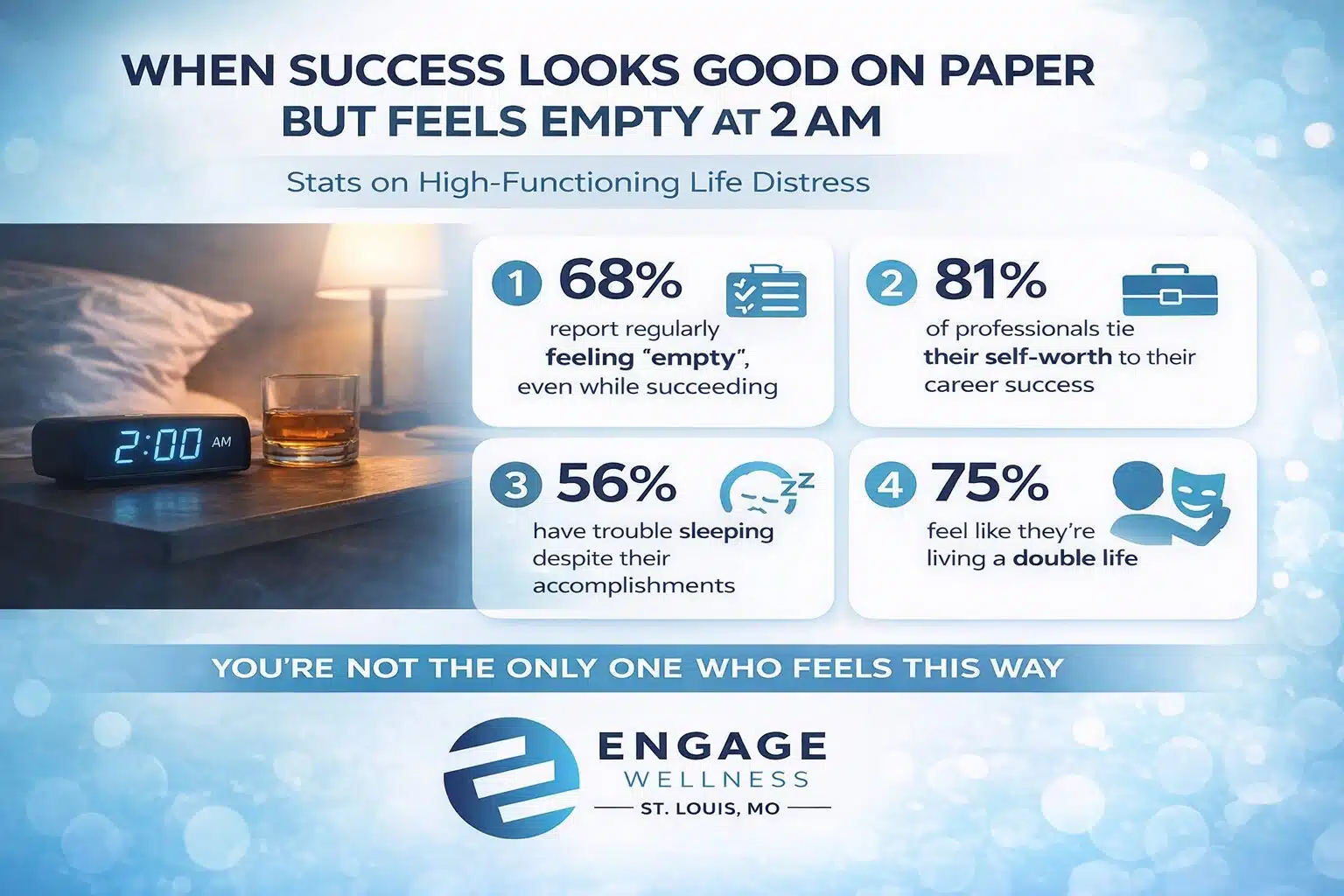
When Success Looks Good on Paper but Feels Empty at 2AM

Written By
IOP
Written By
I didn’t crash my car.
I didn’t miss payroll.
I didn’t lose custody, get arrested, or “hit bottom.”
I just kept waking up at 2AM with my heart racing and a drink on the nightstand.
From the outside, my life worked. Inside, it was duct tape and caffeine and quiet panic.
If you’re high-functioning, you know exactly what I mean. You can deliver a presentation hungover. You can parent through a headache. You can hit deadlines while bargaining with yourself about how much you’ll drink tonight.
You look stable.
You feel brittle.
Within the first few weeks of finally admitting I needed help, I found myself in an Intensive Outpatient Program that didn’t require me to torch my entire life to get better. I didn’t have to disappear. I didn’t have to resign. I didn’t have to explain everything to everyone.
That mattered more than I can explain.
I thought my ability to keep it together meant I was fine.
But functioning is a low bar.
Functioning means you can still show up.
It doesn’t mean you’re at peace.
It doesn’t mean your nervous system isn’t fried.
In multi-day weekly treatment, something uncomfortable happened: I slowed down enough to feel how anxious I actually was.
Not dramatic anxiety. The polished kind. The kind that hides under productivity and perfectionism.
When I wasn’t racing from meeting to meeting, I noticed how much I relied on alcohol (or pills, or whatever your thing is) to land the plane at the end of the day.
I wasn’t celebrating.
I was sedating.
And that realization hurt — but it was honest.
High achievers are great at comparison.
“I’m not as bad as that guy.”
“At least I don’t drink in the morning.”
“I’ve never missed work.”
In group, I heard surgeons, executives, stay-at-home parents, entrepreneurs — all saying versions of the same thing:
“I don’t look like I need help.”
That cracked something open.
Because addiction doesn’t care about your LinkedIn profile. It doesn’t ask how many people report to you. It doesn’t check your GPA.
You don’t have to be falling apart publicly to be unraveling privately.
One of the biggest gifts of structured care was this: I didn’t have to prove I was sick enough. I just had to admit I was tired of doing it alone.
At first, that bruised my ego.
I’m used to being competent. The one people rely on. The one with answers.
In treatment, nobody clapped when I talked about my workload. Nobody praised me for grinding through exhaustion.
They cared about something else:
It was disorienting to be valued for my vulnerability instead of my output.
But here’s the truth: the version of me that always performed was the one slowly breaking.
In that room, I didn’t have to perform.
I could say, “I’m scared that if I slow down, everything will fall apart.”
And instead of advice, I got understanding.
That was new.
I used to think I didn’t need accountability. I was disciplined. Self-motivated. Driven.
But white-knuckling is not discipline.
It’s fear with a calendar.
The rhythm of consistent sessions each week gave my brain something it hadn’t had in years: stability that wasn’t dependent on achievement.
There were expectations. I showed up. I participated. I reflected. I practiced new coping tools outside the room.
But it wasn’t about punishment. It was about practice.
Practice not pouring the drink when stress spiked.
Practice sitting with discomfort without immediately escaping it.
Practice telling the truth about how hard things actually felt.
For someone used to controlling everything, letting someone else hold part of the framework felt… terrifying.
And then it felt relieving.
This one is hard to admit.
There was the version of me everyone saw — capable, sharp, organized.
Then there was the 9PM version. The one bargaining:
“Just two.”
“Tomorrow I’ll reset.”
“I deserve this.”
That split is exhausting.
And dangerous.
Because when you’re high-functioning, your consequences are delayed. You can sustain the illusion longer. Which means the damage happens quietly.
In group, I met other people who lived the same split. One guy ran a company. One woman managed a nonprofit. Another coached youth sports.
All of us had secret rituals. Secret fears. Secret shame.
Hearing someone say, “I look successful, but I feel like a fraud,” hit me in the chest.
I wasn’t uniquely broken.
I was human and overextended and medicating my stress.
Sleep is unconsciousness.
Rest is relief.
Success had given me money, status, stability.
It never gave me rest.
Rest came from saying out loud, “I don’t actually have this under control.”
Rest came from realizing I didn’t have to lose everything to justify changing something.
Rest came from building coping skills that didn’t require a substance at the end of the day.
For the first time in years, my evenings didn’t feel like a secret battle.
They felt… manageable.
Not perfect. Not magically easy.
But honest.
And honesty is lighter than performance.I Rebuilt Self-Respect Without Burning My Life Down
One of my biggest fears was that getting help would mean dramatic upheaval.
But what I found in an Intensive Outpatient Program was something far more sustainable: integration.
I kept working.
I kept parenting.
I kept living in my house.
But I stopped pretending.
That’s the difference.
Recovery didn’t erase my ambition. It recalibrated it. I still care about doing well. I still show up.
I just don’t have to anesthetize myself to survive my own life.
And that is something no bonus or promotion ever gave me.
If you’re reading this and thinking, “But I’m still functioning,” I get it.
That was my favorite defense too.
The question isn’t whether you’re functioning.
The question is whether you’re free.
You don’t have to wait for a public collapse to choose something different. You can quietly explore support that fits into your real life.
Call 314-350-4135 or visit our Intensive Outpatient Program page to learn more about our Intensive Outpatient Program services in St. Louis, Missouri.
Needing help isn’t measured by how much you’ve lost. It’s measured by how much it’s costing you internally. If you’re exhausted, hiding, bargaining, or scared to stop — that’s worth paying attention to.
Many high-functioning professionals choose options that allow them to continue working while attending several sessions per week. The goal isn’t to blow up your life — it’s to stabilize it.
Labels aren’t a prerequisite for change. You can start with something simpler: “I don’t like my relationship with this anymore.” That’s enough.
Group is often a core component because it breaks isolation and secrecy. But programs typically include a mix of group sessions, individual therapy, and skill-building. If the idea of group scares you, that’s normal. It scared me too. It ended up being the thing that helped the most.
Confidentiality is taken seriously. Most professionals in treatment are deeply concerned about privacy. You’re not the only one worried about reputation. The bigger question might be: what is it costing you to keep hiding?
If you’re stuck in a cycle — using, regretting, promising to cut back, repeating — but you’re not in immediate crisis, this kind of structured, multi-day weekly support can be a strong middle ground.
It’s more than once-a-week therapy. It’s less than disappearing into live-in treatment.
For many high-functioning people, that balance makes change actually possible.
You built a life that looks impressive.
Now you deserve one that feels livable.
Call 314-350-4135 or visit our Intensive Outpatient Program page to learn more about our Intensive Outpatient Program services in St. Louis, Missouri.




© 2025 Engage Wellness Acton, MO. All Rights Reserved | SEO by DIGITECH | Sitemap | Privacy Policy
© 2025 Engage Wellness Acton, MO. All Rights Reserved | SEO by DIGITECH | Sitemap | Privacy Policy