
PHP
When You Have to Come Back — And You’re Not Sure You Deserve To

Written By
PHP
Written By
I remember staring at my phone for an hour before making the call.
Ninety days sober. Meetings. Therapy. Morning routines. The whole thing.
And then one night, I told myself it would just be one drink. Or one pill. Or one escape hatch from the pressure building in my chest.
If you’re here because you relapsed after 90 days—or more—and you’re thinking about coming back to treatment, I want to talk to you like a peer. Not like you’re brand new. Not like you forgot everything. But like someone who knows how disorienting this moment is.
Especially if you’re considering returning to a structured daytime care program.
Let’s slow this down.
The first 30 days, people expect it to be hard.
By 90 days, you’re supposed to be “doing well.”
You’ve collected some praise. Maybe some trust back. Maybe you started believing your own stability.
So when relapse happens at this stage, it doesn’t just feel like a slip.
It feels like betrayal.
You might be thinking:
Here’s what I learned the hard way: relapse at 90 days doesn’t mean you didn’t learn anything. It usually means something underneath didn’t get enough attention.
And that’s not the same thing as failure.
Let’s kill this myth gently.
You did not “throw away” your sobriety.
The brain changes that happened in those 90 days? They still happened.
The coping tools you practiced? Still there.
The insights about your patterns? Still yours.
Relapse doesn’t delete growth. It exposes weak spots.
That’s different.
Recovery is less like climbing a ladder and more like strengthening a muscle. Sometimes you overestimate what it can carry. Sometimes you hit fatigue. That doesn’t mean the muscle never grew.
It means it needs more conditioning.
The first time, you might have felt desperate.
This time, you feel embarrassed.
Walking back into treatment—especially something like a Partial Hospitalization Program—can feel like admitting you miscalculated.
But here’s the spicy truth: people who come back after relapse often engage deeper than they did the first time.
Why?
Because now it’s personal.
You’ve seen what happens when stress builds. When isolation creeps in. When mental health symptoms quietly return. When you start negotiating with yourself.
You’re not guessing anymore. You have data.
That makes your second round less about proving something—and more about protecting something.
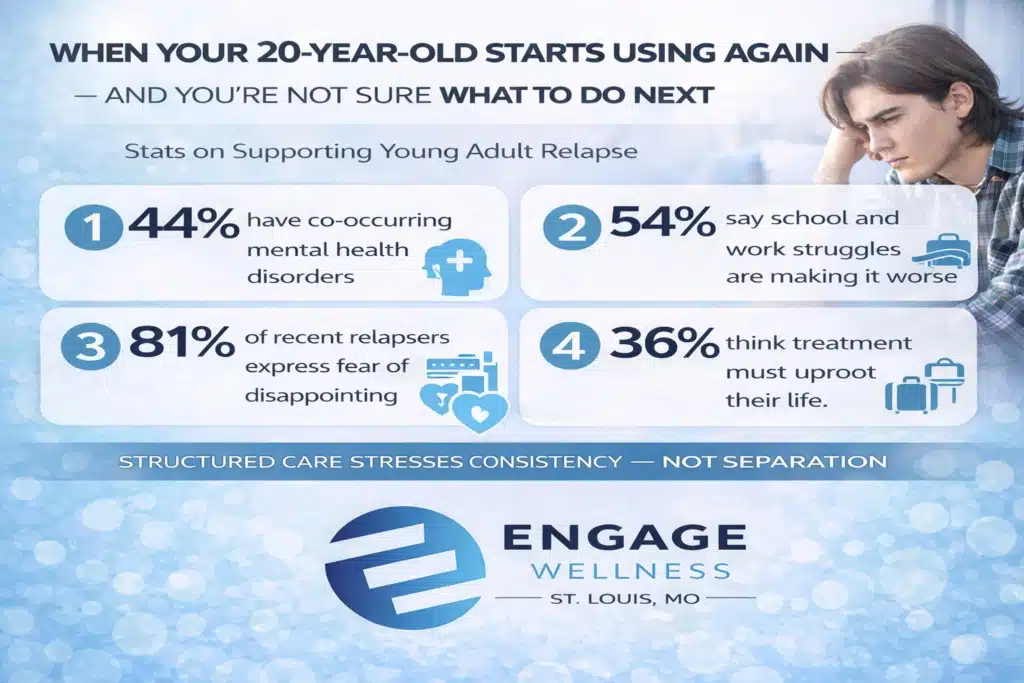
Let’s name some things most of us don’t say out loud:
A structured, multi-day weekly environment can reintroduce rhythm without uprooting your entire life.
It’s not punishment. It’s recalibration.
And sometimes that’s exactly what’s needed.
When someone returns after relapse, they often show up differently:
That shift matters.
You’re not here to collect gold stars. You’re here to understand your patterns in a deeper way.
And structured daytime care gives you space to do that while still going home at night, staying connected to your real life, and practicing skills in real time.
There’s something powerful about that middle level of care. It bridges the gap between “I’m drowning” and “I’ve got this.”
Let’s address it directly.
You’re afraid the staff will be disappointed.
You’re afraid other alumni will think you failed.
You’re afraid you’ll feel like the “repeat offender.”
But here’s what actually tends to happen in good programs:
People respect honesty.
Clinicians understand relapse as part of the clinical picture—not a moral verdict.
And alumni? They usually relate more than you think.
The real risk isn’t coming back.
It’s isolating.
Shame grows in isolation. Recovery grows in connection.
Yes. The 60–120 day window can be especially vulnerable. The initial crisis energy has faded, but long-term habits and stress patterns are still stabilizing. Many people experience slips during this phase. It doesn’t mean treatment “didn’t work.”
It means recovery is still under construction.
No. The first round gave you insight and tools. Returning builds on that. Think of it like adjusting your plan—not scrapping it.
In many cases, yes—especially if there has been a documented relapse or symptom increase. Coverage depends on your specific plan and medical necessity. A treatment team can help assess and verify benefits so you’re not navigating that alone.
You’re more aware of your triggers. You’re less likely to minimize warning signs. You may engage more directly in therapy because you’ve seen the cost of disconnection. Second attempts are often deeper—not weaker.
You don’t owe everyone a press release.
Start with one safe person. Keep it simple: “I hit a rough patch and I’m stepping back into support.”
That’s strength. Not shame.
That fear is actually a sign that you care. Treatment isn’t about guaranteeing you’ll never struggle again. It’s about strengthening your response when struggle shows up. Relapse risk decreases when support increases. Structure matters. And you’re allowed to build more of it.
If you’re reading this, something in you hasn’t given up.
That matters. Relapse can feel like proof that you’re incapable. But the urge to return—to re-engage—suggests the opposite.
It suggests you’re not done fighting for yourself. There’s no rule that says you only get one shot at healing. There’s no policy that says you have to disappear in shame.
And there’s no trophy for pretending you’re fine. Sometimes the bravest move in recovery isn’t staying out forever. It’s coming back sooner.
If you’re in Missouri and feeling that pull toward support again, Engage Wellness MO offers compassionate, structured care designed for moments exactly like this. Their Partial Hospitalization Program provides consistent daytime support so you can stabilize, rebuild, and strengthen your foundation—without stepping completely away from your life.
You don’t have to decide everything today.
You just have to decide not to disappear.
Call 314-350-4135 or visit our Partial Hospitalization Program services in St. Louis, Missouri to learn more about your options.




© 2025 Engage Wellness Acton, MO. All Rights Reserved | SEO by DIGITECH | Sitemap | Privacy Policy
© 2025 Engage Wellness Acton, MO. All Rights Reserved | SEO by DIGITECH | Sitemap | Privacy Policy