
IOP
When You Stopped Showing Up — And Now You’re Not Sure You’re Allowed Back

Written By
IOP
Written By
You didn’t wake up one morning planning to disappear.
It probably happened quietly. A missed group. A hard week. A spike in symptoms. A small voice that said, “I’ll deal with this later.” And now later is here—and it feels heavy.
If you were part of our multi-day weekly treatment and stopped coming, we want to say something clearly:
You are not in trouble.
You are not an inconvenience.
You are not disqualified from coming back.
You’re human.
And rebuilding momentum is possible—even if you feel embarrassed, unsure, or like you’ve “messed it up.”
Let’s walk through how.
When someone drops out mid-treatment, the brain gets loud and mean.
“You quit.”
“You always do this.”
“They won’t take you seriously anymore.”
But stopping attendance is a behavior. It’s not your identity.
Recovery isn’t a personality trait. It’s a practice. And practices get interrupted. Illness flares. Work changes. Family crises happen. Depression makes everything feel heavier than it should.
You didn’t suddenly become incapable. You hit friction.
And friction doesn’t cancel your capacity.
If you showed up for even one week, you proved something important: part of you wants help. That part is still there.
It might help to know you’re not unusual.
People step away from treatment for reasons like:
Sometimes people leave because things are improving and they think, “I’ve got this.”
Sometimes they leave because things are getting worse and they think, “What’s the point?”
Neither makes you weak.
It makes you human under stress.
The biggest mistake we see? Waiting to come back until everything is cleaned up.
You don’t need to:
You don’t need a performance.
A simple message works:
“I stopped coming and I’d like to talk about coming back.”
That’s enough.
In an Intensive Outpatient Program setting, re-entry isn’t rare. It’s part of real-life care. We expect setbacks. We plan for interruptions. Treatment isn’t a straight highway—it’s more like a road with rest stops and detours.
The goal isn’t perfection. It’s return.
One of the biggest fears people carry:
“They’re going to be disappointed in me.”
Here’s what actually happens most of the time:
No lectures. No public shaming. No “I told you so.”
One client once said:
“I walked in ready to defend myself. They just asked how I was doing.”
That’s how it should feel.
We care about your safety and your stability—not about scoring attendance.
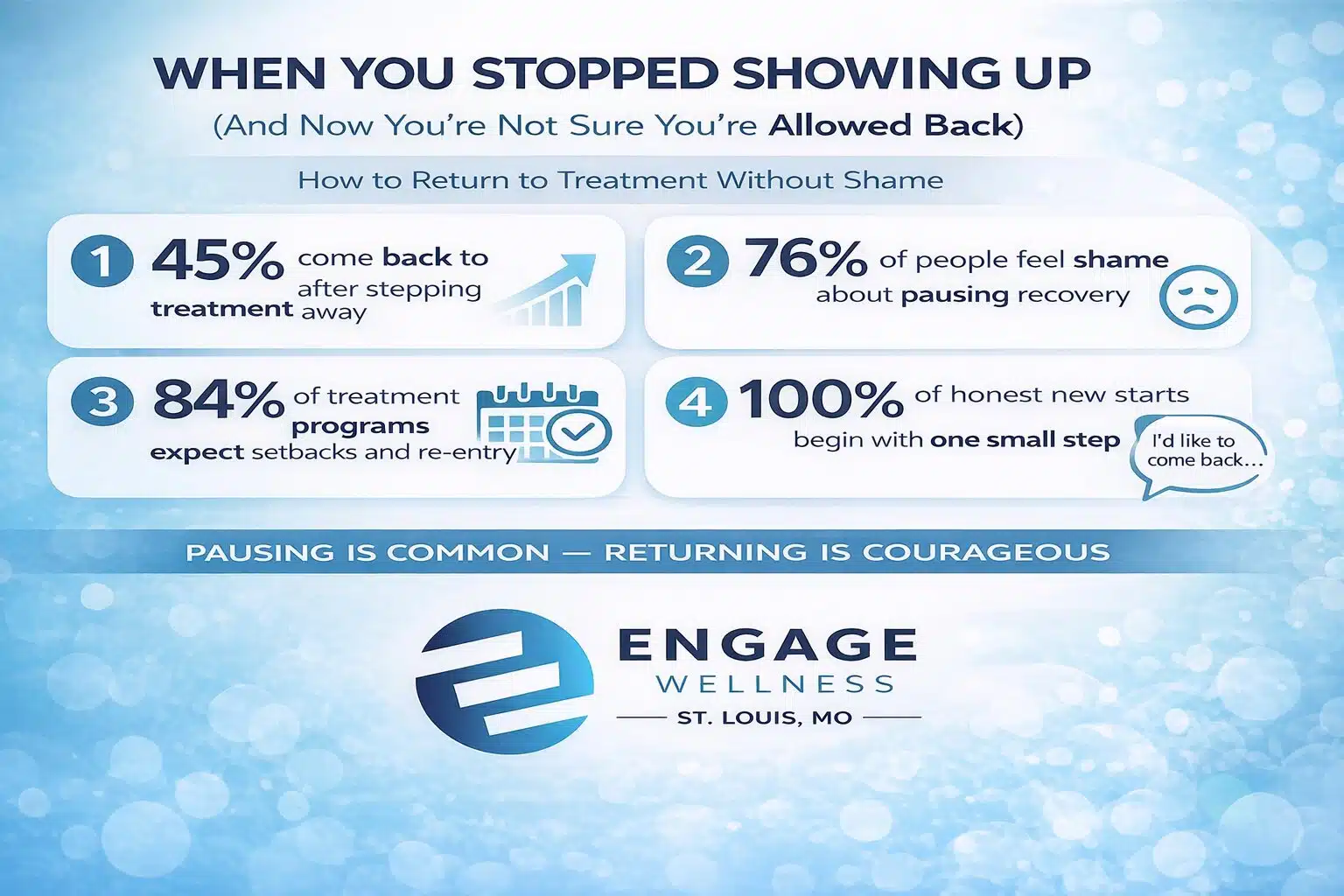
Momentum doesn’t return in a dramatic breakthrough.
It returns in repetition.
If you’re re-entering multi-day weekly treatment, focus on:
Don’t think about finishing the whole program.
Think about today.
Recovery momentum is built like stacking bricks. One at a time. Quietly.
If something specific pulled you away—say it.
That information helps us adjust care.
Maybe you need:
Treatment is meant to respond to real life—not ignore it.
One of the most dangerous thoughts in recovery is:
“If I can’t do it perfectly, I shouldn’t do it at all.”
That mindset leads to disappearing.
But progress isn’t erased by pauses. Skills you learned still exist. Coping strategies you practiced still belong to you.
You are not back at zero.
You’re continuing—with more data.
When people consider coming back, they often forget the pain that led them to begin.
Ask yourself gently:
If any of that is still true—or starting to become true again—that’s information.
You don’t have to wait for things to collapse.
Coming back early is strength.
This isn’t marketing language. It’s clinical reality.
Programs are built with the understanding that engagement fluctuates. People return after weeks. After months. Sometimes after longer.
There is no punch card.
There is no “one chance only” rule.
There is no moral scoreboard.
There is just the next step.
And it’s available to you.
Yes. Relapse is not an automatic disqualification. In fact, it’s often a sign that more support—not less—is needed. The purpose of care is to respond to real life, not to pretend setbacks don’t happen.
If you relapsed, be honest about it. That helps us determine what level of structure is most appropriate right now.
Not necessarily. Group settings focus on the present. If you choose to share about your absence, you can. If you don’t, you’re not required to give a detailed explanation to anyone except your clinical team.
Re-entry doesn’t require public disclosure.
Embarrassment is common. It’s also temporary. The anticipation is usually worse than the reality. Most people are focused on their own healing—not judging yours. And many group members understand more than you think. Quietly, a lot of people have left and returned at some point in their recovery.
That’s important information—not a reason to stay away. If anxiety, depression, cravings, or mood instability have increased, structured care can help stabilize things before they spiral further. Treatment adapts to where you are now—not where you were when you left.
Not always. Re-entry plans depend on how long you were away and what changed during that time. Sometimes you resume where you left off. Sometimes adjustments are made. The focus is on forward movement—not punishment.
You don’t have to feel 100% ready. Readiness often grows after action—not before. If part of you is considering coming back, that’s enough to start a conversation.
You’re still welcome. Avoidance is common when people feel overwhelmed or ashamed. Silence doesn’t close the door.
Reaching back out is allowed—even if time has passed.
You don’t need to prove anything to come back.
You don’t need to explain yourself perfectly.
You don’t need to arrive polished.
You just need to arrive.
If you’ve been away and you’re unsure how to step back in, our team is here. We’re not keeping score—we’re keeping the door open.
Call 314-350-4135 or visit our multi-day weekly treatment options to learn more about our Intensive Outpatient Program services in St. Louis, Missouri.




© 2025 Engage Wellness Acton, MO. All Rights Reserved | SEO by DIGITECH | Sitemap | Privacy Policy
© 2025 Engage Wellness Acton, MO. All Rights Reserved | SEO by DIGITECH | Sitemap | Privacy Policy