
PHP
When Your 20-Year-Old Starts Using Again — And You’re Not Sure What to Do Next

Written By
PHP
Written By
You thought the worst was behind you.
There was treatment. There were hard conversations. Maybe there were tears, family sessions, hopeful milestones. For a while, things felt steadier.
And now you’re noticing the shift.
The defensiveness. The exhaustion. The familiar edge in their voice. The gut-level fear that whispers, We’re here again.
If you’re the parent of a 20-year-old who has started using again, you may feel grief layered on top of guilt layered on top of exhaustion.
As a clinician, I want to say this clearly: relapse is not proof of bad parenting. It’s not evidence that your child is beyond help. And it does not erase the progress they’ve already made.
Sometimes it means the level of support needs to change.
If you’re exploring options, you may have come across a structured daytime treatment program that provides more consistency and clinical depth than weekly therapy, while still allowing your young adult to live at home.
Let’s slow this down and talk about what that could mean for your family.
One of the most painful thoughts parents carry is:
“We’re starting over.”
But growth doesn’t disappear because someone slipped.
Your 20-year-old still has insight. They still have language from prior treatment. They still have memory of what it felt like to be clearer, steadier, healthier.
Relapse often signals that something underneath hasn’t been fully addressed — or that new stressors overwhelmed existing coping skills.
At 20, life is intense.
Identity shifts. Breakups. Academic pressure. Social comparison. Financial anxiety. Fear of failure. Fear of adulthood itself.
Substances can become a shortcut for relief.
When that shortcut returns, it usually means pain has returned.
Structured daytime care gives space to unpack that pain before it calcifies into something more dangerous.
Weekly therapy can be incredibly helpful.
But sometimes, it’s like trying to put out a house fire with a garden hose.
If your young adult is:
They may need more than a single hour per week.
They may need daily therapeutic engagement. Ongoing accountability. Peer support. Medical monitoring if necessary.
That middle level of care exists for exactly this scenario — when someone needs more structure than outpatient therapy, but doesn’t require round-the-clock residential care.
Parents sometimes worry that more treatment feels like punishment.
For many young adults, it actually feels stabilizing.
A consistent weekly schedule.
Therapy multiple days in a row.
Skill-building sessions that don’t fade after 60 minutes.
Group conversations where they’re not the only one struggling.
This kind of rhythm can regulate a nervous system that’s been living in chaos.
Think of it like scaffolding around a building under repair. The structure doesn’t mean the building is weak. It means we’re reinforcing it while healing happens.
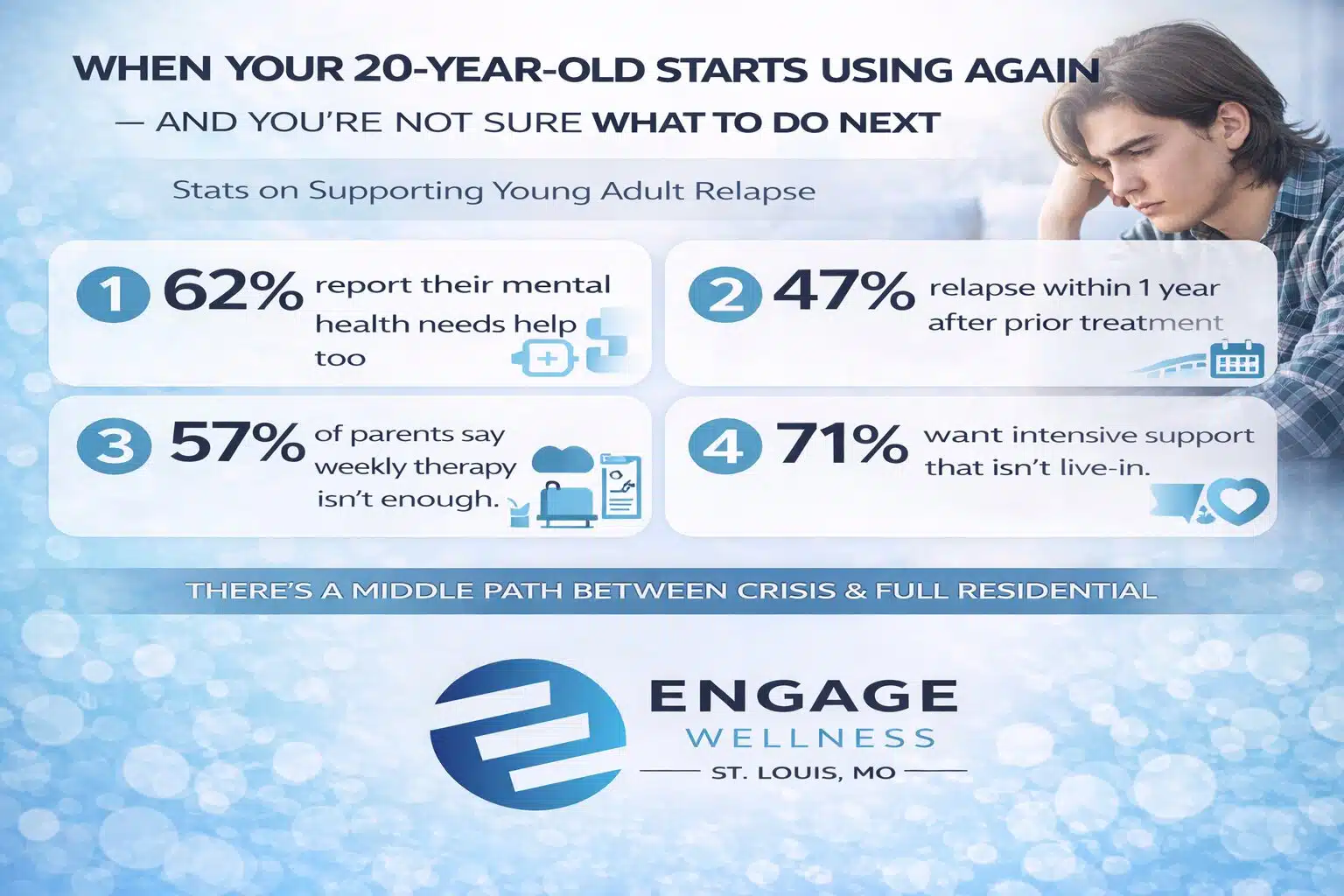
When a Partial Hospitalization Program is the right fit, it offers that scaffolding — not as a sentence, but as support.
Many families focus first on the substance use.
And yes, it matters.
But often, underneath the return to using is something else:
When mental health and substance use collide, treating one without the other rarely works long-term.
Young adults especially may struggle to articulate what they’re feeling. Substances become a way to quiet something they don’t yet have language for.
More intensive daytime treatment allows clinicians to address both sides of the equation at the same time — consistently, not sporadically.
That dual focus can be the difference between temporary stabilization and real traction.
At 20, independence matters.
Your child may resist the idea of going back to live-in care. They may want to stay connected to friends, school, or work. They may not see themselves as someone who “needs rehab again.”
That’s where structured daytime treatment can bridge the gap.
They can:
This allows them to practice coping skills in their actual environment — not in a bubble.
It’s support without complete removal from life.
Parents often carry the invisible weight of this season.
Monitoring. Worrying. Reading signs. Sleeping lightly.
Trying not to overreact. Trying not to underreact.
Higher levels of care create a team around your young adult. You’re no longer the sole emotional first responder.
Family sessions, communication coaching, and clinical guidance can help you recalibrate your role — so you’re supportive without becoming the therapist.
That shift can protect your relationship.
And protecting the relationship matters deeply at this age.
There’s a myth that someone has to “hit bottom” before change sticks.
Clinically, we know that’s not true.
Early intervention — especially after a slip — often prevents deeper consequences.
Legal trouble. Academic failure. Health crises. Overdose risk.
When support intensifies quickly, we can interrupt the spiral before it accelerates.
Hope isn’t naïve. It’s strategic.
If substance use is recurring, mental health symptoms are worsening, or you’re seeing patterns of dishonesty, isolation, or volatility, it may signal that weekly support isn’t enough. A higher level of care doesn’t mean things are catastrophic. It means you’re adjusting support to match reality.
It depends on how it’s framed. If it’s presented as “You messed up again,” resistance is likely. If it’s framed as, “We see you struggling. Let’s increase support so you don’t have to carry this alone,” it lands differently. Young adults often feel relief when someone names that they’re overwhelmed.
Resistance is common. A calm, united parental stance helps. So does involving a clinician early in the conversation. Sometimes framing it as a short-term reset rather than a long-term commitment reduces defensiveness.
Often, yes — depending on the program schedule and the severity of symptoms. One advantage of structured daytime care is flexibility. It supports recovery while maintaining aspects of daily life when appropriate.
Relapse is common in young adulthood, especially when underlying mental health needs are still stabilizing. That doesn’t mean it should be ignored. It means it should be addressed with the right level of care.
Then you’re human. You’re allowed to be tired. You’re allowed to be scared. You’re allowed to not know what the perfect answer is. You don’t have to carry this alone, either.
There’s a specific kind of heartbreak that comes when your young adult slips after progress.
It feels like watching hope crack.
But cracks don’t mean collapse.
They mean attention is needed.
If you’re wondering whether more structured support could help your child regain stability, it may be time to explore whether a Partial Hospitalization Program fits your family’s situation.
You don’t have to commit to forever. Just to the next step.
Call 314-350-4135 or visit our Partial Hospitalization Program services to learn more about our Partial Hospitalization Program services in St. Louis, Missouri.




© 2025 Engage Wellness Acton, MO. All Rights Reserved | SEO by DIGITECH | Sitemap | Privacy Policy
© 2025 Engage Wellness Acton, MO. All Rights Reserved | SEO by DIGITECH | Sitemap | Privacy Policy